
Story Versus Fact in Son of Nobody by Yann Martel
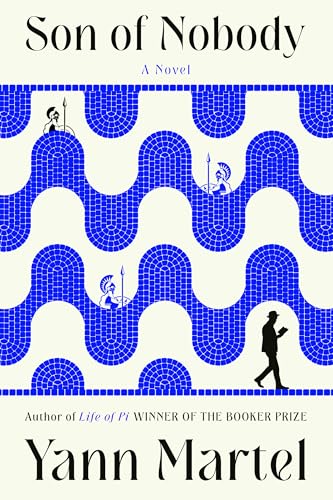
Maybe we’ve always lived in a post truth world. One where we’ve always dreamed of meeting our gods. Once we would all get the chance to meet Hades, until we killed him, too.
I didn’t expect to like Son of Nobody by Yann Martel as much as I did. I’m rarely a fan on books that play with form. They frequently catch me in the change and I spend more time thinking about how this different way of writing doesn’t work. Son of Nobody plays with form, and it does it well.
Canadian Classicist Harlow Donne travels to Oxford to take part in a great study of papyrus found in an ancient site, while there he comes across accounts of Psoas, Son of Nobody, a new telling of the Trojan War. Donne decides to stay in search of the new epic The Psoad and documents not only the poem, but his thoughts as the poem comes together.
Half of the book is a telling of The Psoad, written in the style of Greek verse like The Iliad or The Odyssey. The other half is Donne’s life told in the footnotes. Some footnotes explain the poem in more detail, but others follow what’s happening in Donne’s life, with his supervisor, his wife, and his daughter Helen.
The form works really well. It feels like reading someone’s thoughts as they’re explaining a big project they worked on. Sometimes topical, often informative, but as life builds momentum the focus shifts from the examination more and more.
Son of Nobody explores some eternal themes: life, death, loyalty, family; and shows how some modern concepts aren’t so modern after all.
How the epic poems became substitutes for facts and how we can integrate a story into our lives and our culture more solidly than any truth.
After all, let’s be real, did the Mycenaeans really spend a decade laying siege to one city? Did they manage, after all this, to build a massive wooden horse so structurally sound that it could be wheeled inside the walls with fifty men inside? Where the Trojans, after ten years of violence, so naïve to let it through the gates? The epic poems are less about fact, more about a view of the world.
When Virgil was commissioned to write the Aeneid, in the style of an old epic to rewrite the history of Rome, he knew that the stories of Homeric epics were much more important than the facts. The goal was to create entertainment that becomes the fact, not entertainment beholden to the facts.
This has always been common and still is. Movies and tv shows “based on a true story” have the power to rewrite history, the events presented on screen become the only reality that many people know. If biopics, historical epics, or movies about influential events present an unreality, for many people, that’s the only version of the world that they know.
Should we all verify the events after watching a show? Probably. Do we? No. Will we? Also no. At some point the reality becomes less important than the shared story.
Donne’s perception of story, fact, and truth gets pulled into focus more as the book goes on. The footnotes are his epic poem, his perspective that isn’t always the truth, but is solid enough that he can build upon it
At times The Psoad lags, there are passages that feel longer than they need to be and I found myself rushing over them. The form does make it disjointed and a slapdash insight into a person’s world. I find that it works, but it results in a less cohesive narrative than I would usually be drawn to.
Overall, Son of Nobody is a definite recommended read from me. You don’t need any basis in the Homeric epics to enjoy it, everything you need to know will be explained. If you’re the kind of people who views retellings or adaptation as the greatest travesty ever committed to culture, then maybe give it a miss.
Maybe also avoid the eBook version, I don’t know how well the formatting tricks will work there.
Otherwise, give it a go: decide for yourself what is story, and what is real, and if that distinction matters any more, or if it ever did.
One quick thing:
Before reading, look up the word “uxorious”.
Maybe you already know it, but probably you don’t, I definitely didn’t. Sometimes things are lost to time for good reason.